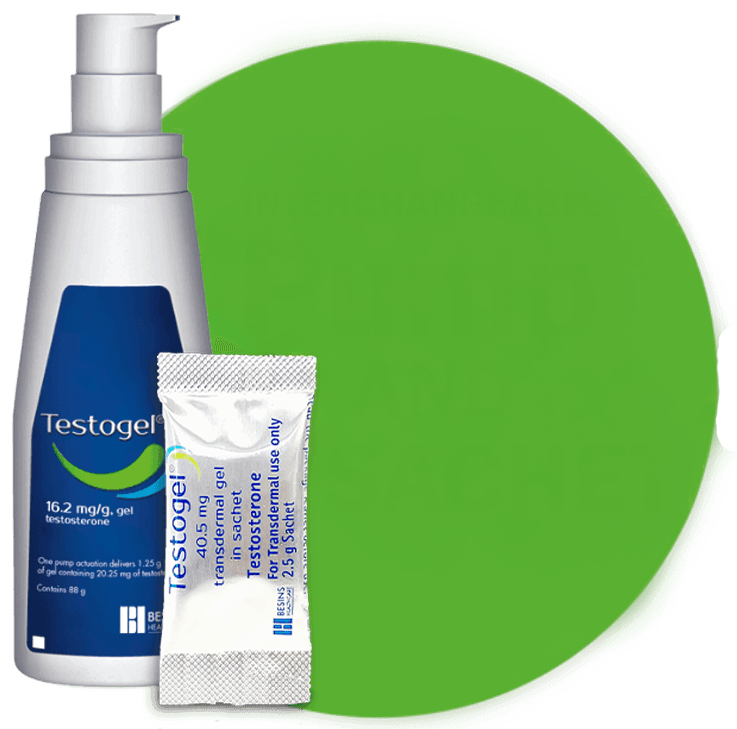


Testogel is indicated in adults as testosterone replacement therapy (TRT) for male hypogonadism when testosterone deficiency (TD) has been confirmed by clinical features and biochemical tests.1,2
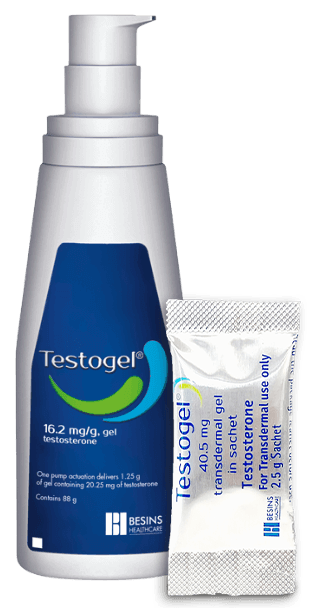

The recommended daily dose is two pump actuations. Alternatively, one sachet provides the same daily recommended amount in a convenient, pre-measured format. The gel should be gently spread as a thin layer on the skin—rubbing in is not necessary. Dose adjustments are possible in increments of one pump actuation of gel, or with half sachets not exceeding 81 mg testosterone per day (4 pump actuations or 2 sachets).*,1,2
This gives patients the flexibility to easily switch between either products
*Testosterone levels should be monitored at baseline and at regular intervals during treatment. Clinicians should adjust the dosage depending on the clinical or laboratory response in individual patients.

The gel should be administered by the patient himself, and spread thinly onto clean, dry, healthy skin over both upper arms and shoulders. It is not necessary to rub Testogel on the skin. The gel should be allowed to dry for 3-5 minutes.
After application, they should wash their hands with soap and water, and cover the application site(s) with clothing after the gel has dried.1,2
Testogel is flammable until dry.
Please advise your patient not to apply Testogel to the genital areas as the high alcohol content may cause local irritation.1,2

Allow 1 hour before washing
If skin-to-skin contact of the application site with another person is anticipated by the patient, the site should be washed thoroughly with soap and water prior to contact.
Patients should wait at least 1 hour before washing the site.1,2

Consistent supply since 2020 - Prescribe with confidence as both the Testogel pump and sachet has had consistent supply since 2020.3

Careful and regular monitoring of the prostate gland, by DRE and PSA, and breast must be performed at least once yearly. Monitoring should be conducted twice yearly for elderly and at-risk patients (those with clinical or familial risk factors)1,2
Testosterone levels should be monitored at baseline and at regular intervals during treatment and dosage should be adjusted individually to ensure maintenance of eugonadal testosterone levels1,2
In patients receiving long-term testosterone therapy, the following laboratory parameters should also be monitored regularly: haemoglobin, and haematocrit (to detect polycythaemia), liver function tests, and lipid profile1,2
Recommendations for monitoring with testosterone therapy4 | Timing4 |
|---|---|
Assess the response to therapy and aim for a target level of total testosterone 15–30 nmol/L to achieve optimal response | 3–6 months, 12 months and every 12 months thereafter |
Monitor haematocrit before treatment, and decrease dosage, or switch preparation if haematocrit >0.54
| 3–6 months, 12 months and every 12 months thereafter |
Assess prostate health by PSA and, ideally, DRE before commencing TRT followed by PSA at regular intervals
| 3–6 months, 12 months and every 12 months thereafter |
Assess CV risk before TRT is initiated and continue to monitor CV risk-factors | Throughout treatment |
Recommendations for monitoring with testosterone therapy4
Assess the response to therapy and aim for a target level of total testosterone 15–30 nmol/L to achieve optimal response
Timing4
3–6 months, 12 months and every 12 months thereafter
Recommendations for monitoring with testosterone therapy4
Monitor haematocrit before treatment, and decrease dosage, or switch preparation if haematocrit >0.54
- If haematocrit remains elevated, consider stopping and re-introduce at a lower dose
Timing4
3–6 months, 12 months and every 12 months thereafter
Recommendations for monitoring with testosterone therapy4
Assess prostate health by PSA and, ideally, DRE before commencing TRT followed by PSA at regular intervals
- Increase of PSA >1.4 ng/mL over any 1 year period or a velocity >0.4 ng/mL/year during sequential measurement over >2 years warrants urological evaluation and more intensive surveillance for prostate cancer
Timing4
3–6 months, 12 months and every 12 months thereafter
Recommendations for monitoring with testosterone therapy4
Assess CV risk before TRT is initiated and continue to monitor CV risk-factors
Timing4
Throughout treatment

Safety warning
Testogel contains alcohol and is flammable until dry.
Testogel transfer risk
Patients should be informed to avoid contact between the application site of testosterone gel and others due to transfer risk. Secondary transmission via clothes is possible, so extra caution is needed. After one hour, wash the site with soap and water and cover with clean clothing before close contact with another person. If contact occurs, wash the area immediately with soap and water and consult a healthcare professional. This product contains ethanol, which can cause severe reactions and toxicity in neonates due to significant absorption in immature skin.1,2
References
- 1Testogel 16.2 mg/g gel - Summary of Product Characteristics (SmPC) Available at: https://www.medicines.org.uk/emc/product/8919/smpc. Accessed November 2025
- 2Testogel 40.5 mg, transdermal gel in sachet - Summary of Product Characteristics (SmPC) Available at: https://www.medicines.org.uk/emc/product/13255/smpc. Accessed November 2025
- 3Data on file. REF-TES-00416
- 4Hackett G, et al. World J Mens Health. 2023;41(3):508–537
MAT-PROMO-TES-0140 November 2025
Adverse event reporting
Adverse events should be reported. Reporting forms and information can be found at yellowcard.mhra.gov.uk or search for MHRA Yellow Card in the Google Play or
Apple App Store. Adverse events should also be reported to Besins Healthcare (UK) Ltd Drug Safety on 0203 862 0920 or Email: drugsafety@besins-healthcare.com
To get in touch with Besins for any of the following:
- Meeting with a Besins representative
- Requesting a placebo demonstration pump
For medical information queries, please email information@besins-healthcare.com